
DynElectro sets new world record for electrolysis stack durability: 25,000 hours with near-zero degradation
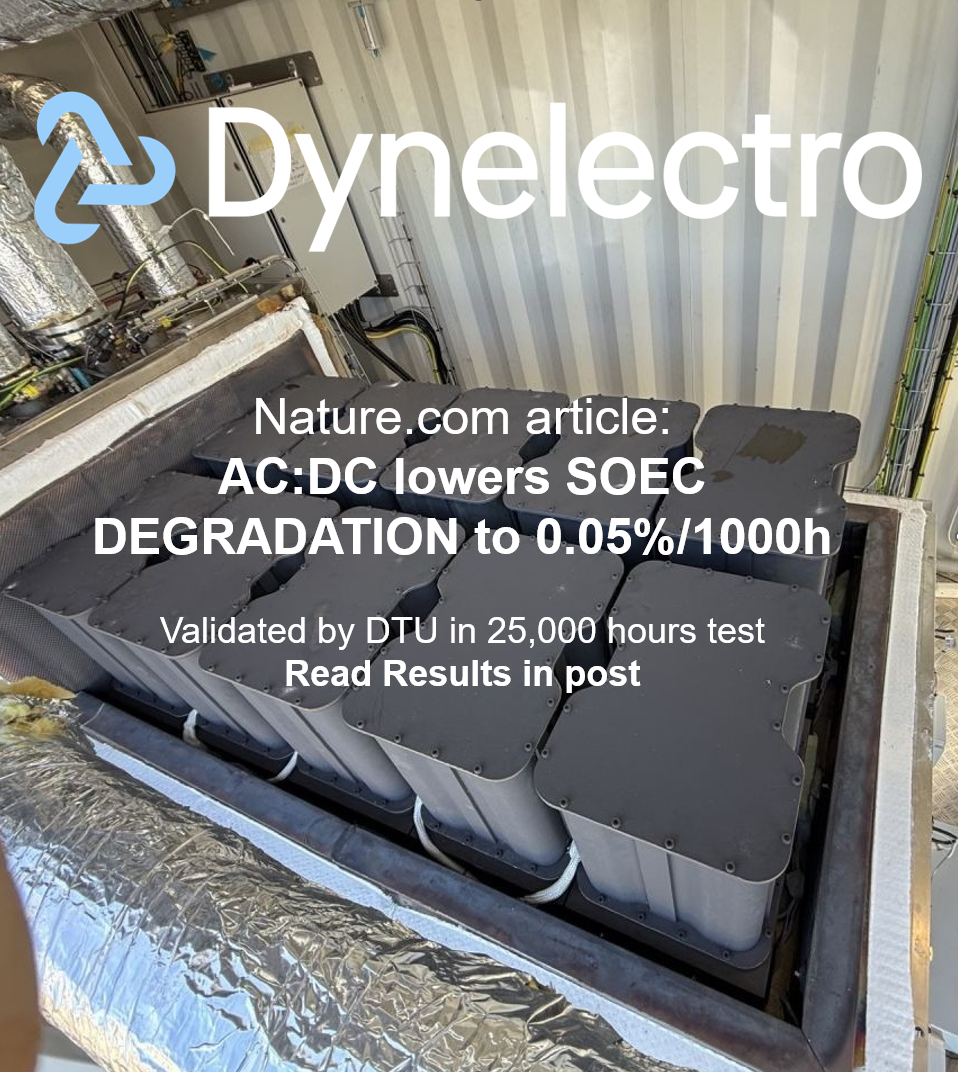
DynElectro sets new world record for Solid Oxide electrolysis stack durability: 25,000 hours with near-zero degradation
Published in Nature Communications, the results show that DynElectro’s patented AC:DC operation reduces degradation of solid oxide electrolysis stacks to one tenth of the EU’s 2030 target.
Viby Sjælland, Denmark, September 25th 2026.
DynElectro ApS, SolydEra, Aalborg University and DTU Energy at the Technical University of Denmark have published the results of a 25,000-hour test of an industrial 70-cell solid oxide electrolysis (SOEC) stack from SolydEra in Nature Communications. The stack ran on DynElectro’s patented AC:DC operation with continuous hydrogen production for almost three years. To the authors’ knowledge, it is the longest SOEC operation and the lowest degradation ever reported for a full stack. The previous full-stack record was around 9,500 hours.
From promising interim result to documented record
In January 2024, SolydEra and DynElectro announced that AC:DC operation had shown exceptionally low degradation after 15 months of testing. The companies said this pointed to a five-fold improvement in stack lifetime. At the time, DynElectro said testing would continue, along with an investigation of the degradation seen during the initial start-up period. The test has now run for more than 25,000 hours. The peer-reviewed results confirm that the low degradation held for the full duration. They also show that the early degradation was linked to the initial conditioning and optimisation of the test setup, and it did not return.
Degradation far below the EU target
After an initial conditioning period, the stack performance stabilised. Over the remaining 22,000 hours, the stack voltage rose by only 0.05% per 1,000 hours. That is one tenth of the EU’s 2030 target of 0.5% per 1,000 hours for solid oxide electrolysis and even below the 2030 targets for competing technologies such as Alkaline and PEM.
Even the most conservative figure clearly beats the target. The average across all 25,000 hours is 0.23% per 1,000 hours, less than half the EU target. This figure includes the start-up and optimisation phase and a period of conventional DC operation. The stack is a commercial SolydEra product, and as previously assesed by by SolydEra, the reduced degradation as result of applying Dynelectro’s propietary AC:DC technology enables a fivefold lifetime performance improvement – from a degradation point of view, stack life is extended from 2 to 10+ years.
Confirms earlier results at full scale
The AC:DC principle briefly and periodically reverses the stack’s polarity from electrolysis to fuel cell mode. This balances heat generation inside the stack and relieves the electrochemical stress that normally wears down the electrodes. DynElectro first documented the reduced degradation in Journal of Power Sources (2022). The new study confirms the effect at industrial full-stack scale and over a period almost 2.5 times longer than the 2nd longest testing duration.
During the test itself, the effect was clear. In a period of conventional DC operation, the stack degraded by about 11.5% per 1,000 hours. Switching to AC:DC operation brought this down to under 1% during run-in, stabilising at 0.05%/1000h during long-time operation.
Test results confirmed by DTU – Technical University of Denmark
Researchers at DTU Energy carried out the impedance analysis and the post-mortem microstructural characterisation of the cells after the test. The analysis showed that the typical degradation signatures of DC electrolysis had not developed to a measurable extent:
- Fuel electrode nickel migration away from the electrolyte
- loss of electrical contact in the nickel network
- silica contamination
- cracking at the electrode interface
All eight monitored cell groups behaved uniformly throughout the test.
Durability is the key to competitive green hydrogen
High-temperature SOEC is the most electrically efficient way to produce hydrogen, but up until now, high degradation has reduced stack lifetime to less than 20.000 hours, which has limited commercial adoption. SOEC electrolysis becomes competitive against other electrolysis technologies once stack lifetime exceeds about 40,000 hours. At a degradation rate of 0.05% per 1,000 hours, the projected lifetime is more than a decade. The AC:DC operation requires no change to cell materials or stack design. It is therefore compatible with existing stacks and can scale directly.
“This result shows that durability is not only a question of materials but of how the stack is operated. With AC:DC operation, we can make existing, industrial SOEC stacks last long enough for hydrogen from solid oxide electrolysis to become competitive. For DynElectro, the publication is an important milestone on the way to commercialising our Dynamic Electrolyser Units,” says Søren Højgaard Jensen, Founder and CTO of DynElectro and professor at Aalborg University.
DynElectro has deployed the patented AC:DC technology as an integrated part of their Dynamic Electrolyser Units, used in multiple pilot and commercial projects in Europe. Dynelectro will soon add a 1 MW DEU in the Netherlands to their growing list of reference plants.
Key figures
- 25,000 hours of operation (about 2.9 years) with a full 70-cell SolydEra stack, 750 °C, −0.5 A/cm²
- 0.05%/kh degradation proven through stabilised AC:DC operation following run-in (EU 2030 target: 0.5%/kh)
- 0.23%/kh average over the entire test, including conditioning and DC periods
- Previous full-stack record: about 9,500 hours
The article
Bilalis, V., et al. Record stack durability in industrial solid oxide steam electrolysis through operational control. Nature Communications (2026). https://doi.org/10.1038/s41467-026-78001-1
About Dynelectro
Founded in 2018, Dynelectro is a Danish solid-oxide electrolyser OEM driving industrial decarbonisation and energy resilience through high-efficiency renewable hydrogen solutions. Leveraging high-temperature SOEC efficiency, our proprietary AC:DC architecture delivers the extended stack lifetime and fast dynamic operation required to unlock the commercial business case for renewable hydrogen.
Dynelectro’s modular approach lets a single Dynamic Electrolyser Unit design scale from 250 kW validation systems to +20 MW industrial installations. Dynectro commercialises its MW-scale systems to deliver the lowest Levelized Cost of Hydrogen (LCOH), enabling cost-effective e-hydrogen for e-fuels, ammonia and transitioning industrial sectors.
Dynelectro is backed by VSquared Ventures, PSV Hafnium, Footprint Fund, Yara Growth Ventures, EIFO and the EIC Fund/European Investment Bank.
Contact:
Søren Højgaard Jensen, Founder/CTO, DynElectro ApS
soren@dynelectro.dk